
In this article (13 sections)
- Let me tell you a familiar story…
- The “Appointment Grid” Illusion: Why PMS Software Falls Short
- The 3 Breakpoints Where Multi-Stage Cases Vanish
- 1. The “Pain-Relief” False Finish
- 2. The Manual Spreadsheet & Sticky Note Trap
- 3. Context-Free Patient Outreach
- Shifting to Treatment Lifecycle Management
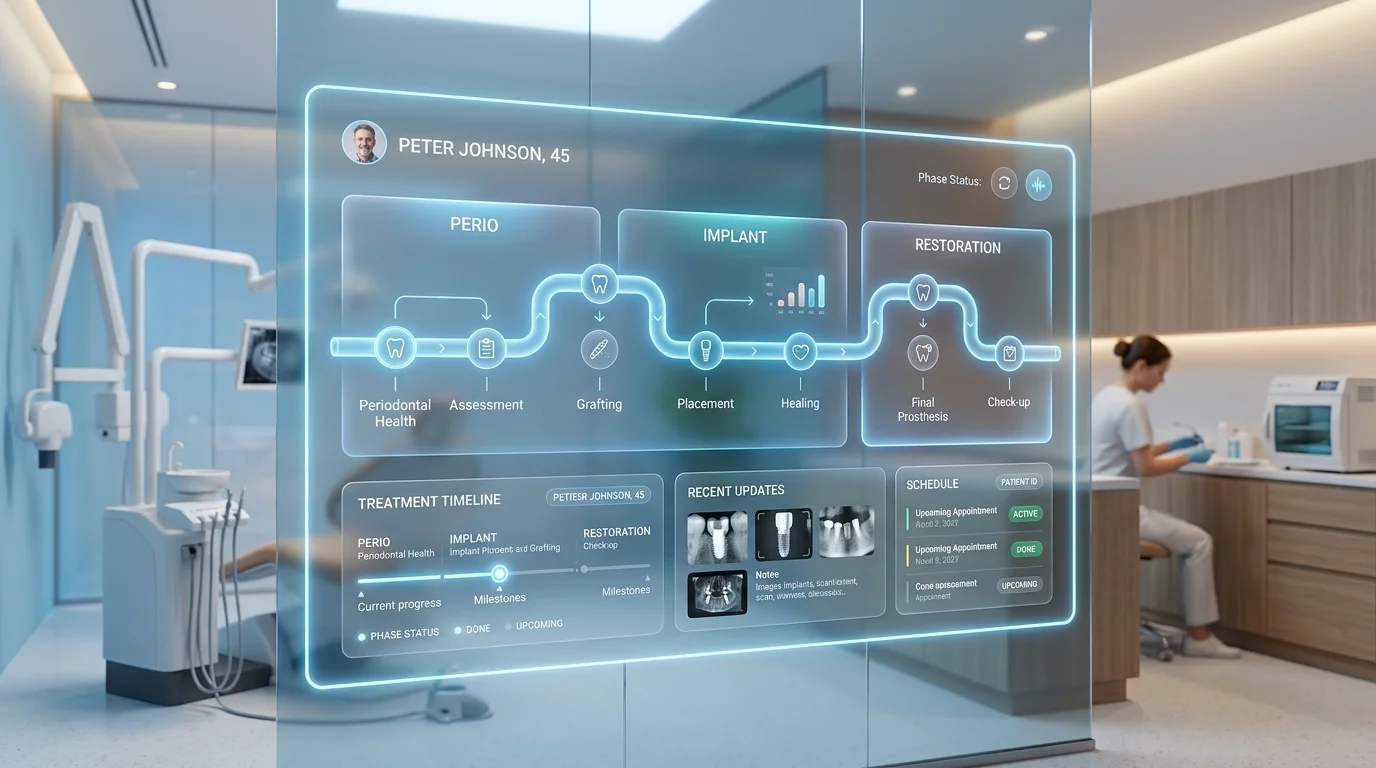
- 1. Visual Stage Pipelines
- 2. Automated Milestone Timers
- 3. Patient-Facing Visual Roadmaps
- The DSO & Practice Economics: Recovering Lost Production
- Practice Audit: Is Your Case Pipeline Leaking?
- Summary
Let me tell you a familiar story…
It’s a typical Monday morning. Dr. Marcus walks out of Operatory 3 feeling confident. He just diagnosed a comprehensive $6,500 multi-stage restorative plan for a patient named David:
- Full-mouth scaling & root planing (SRP)
- Tooth #19 non-restorable extraction + ridge preservation bone graft
- Implant placement & screw-retained zirconia crown
David agrees to begin care and completes his initial deep cleaning right then and there. At check-out, David’s gums feel cleaner, the acute bleeding has stopped, and he utters the exact phrase every dental front desk hears multiple times a day:
“I need to check my work calendar before scheduling the extraction and implant surgery. I’ll call you next week to book.”
The treatment coordinator smiled, clicked “Complete & Check Out” in the Practice Management Software (PMS), collected the co-pay, and moved on to the next patient in line.
Fast forward 90 days.
David never called back. But more importantly: nobody on the clinical team noticed.
David didn’t cancel an appointment. He didn’t no-show. In the eyes of the PMS calendar, David was not an active problem because there was no red box on today’s schedule. His chart was filed away under “Completed Visits,” while $5,000 in vital restorative dentistry quietly evaporated into chart purgatory.
The “Appointment Grid” Illusion: Why PMS Software Falls Short
Most dental clinics rely on legacy Practice Management Software architectures developed decades ago. At their core, these systems are appointment-scheduling and billing ledgers, not clinical case pipeline engines.
Patient In Chair (Initial Phase Complete)
Patient completes initial deep cleaning or urgent pain-relief treatment. Acute symptoms resolve, and the patient expresses intent to “call back next week” to schedule remaining phases.
Checkout & Calendar Archiving
The front desk marks the visit as “Completed” and posts the copay. Because no appointment date is entered, the patient ceases to exist on the active daily schedule.
The 400-Row Unscheduled PDF Report
The chart lands inside a massive, unranked “Unscheduled Treatment” PDF export. Lacking clinical milestones or automated timers, coordinators rarely have the bandwidth to work through the backlog.
Silent Case Attrition ($5,000+ Evaporated)
Over 80% of multi-stage restorative cases quietly drop off. Months later, the patient returns through the emergency door with an irreparable tooth fracture or severe bone resorption.
This structural limitation creates a massive operational blind spot:
| Traditional Appointment Model (PMS) | Patient Treatment Lifecycle Model |
|---|---|
| Core Question: “Is Operatory 2 filled at 2:00 PM today?” | Core Question: “Where is this patient along their clinical roadmap?” |
| An unscheduled patient is invisible on the daily view. | An unscheduled clinical stage triggers an active pipeline alert. |
| Relies on static, 50-page monthly “Unscheduled Treatment Reports.” | Uses real-time stage-by-stage visual pipelines (Kanban-style). |
| Measures performance strictly by daily chair utilization. | Measures performance by case completion rate & lifetime care value. |
When clinic workflows are bounded by calendar blocks, practices only manage patients who are currently scheduled. The 30% to 40% of diagnosed restorative care stalled between treatment phases remains completely untracked.
The 3 Breakpoints Where Multi-Stage Cases Vanish
Why do multi-step cases systematically fall apart after the first visit? Clinical and operational analyses point to three friction points:
1. The “Pain-Relief” False Finish
When patients experience symptomatic relief after Phase 1 (e.g., deep cleaning resolves bleeding gums, or an emergency pulpectomy relieves acute pain), their subjective urgency drops to zero.
Without a structured, visual roadmap reinforcing that Phase 1 was merely the foundation for bone and crown stability, patients assume their treatment is “done” until a cusp fractures 8 months later.
2. The Manual Spreadsheet & Sticky Note Trap
Because traditional dental software lacks dynamic milestone tracking, treatment coordinators (TCs) resort to ad-hoc workarounds:
- Colored sticky notes stuck around front-desk monitors
- Disconnected Excel / Google spreadsheets
- Huge, unranked “Unscheduled Treatment” PDF exports generated once a month
When front-desk staff juggle incoming emergency calls, insurance verification, and morning check-ins, manual spreadsheet follow-ups are inevitably abandoned.
3. Context-Free Patient Outreach
When an administrator finally has time to call down an unscheduled list, the outreach typically sounds like a transactional cold call:
“Hi David, we noticed on our system you have unscheduled treatment remaining. Would you like to schedule an appointment?”
To the patient, this sounds like a sales pitch.
In contrast, an automated lifecycle tracking system like the OriginTechX Solution Studio↗ equips the team with immediate clinical milestone context:
“Hi David, Dr. Marcus noted that your gums have had 4 weeks to heal following your deep cleaning. We need to evaluate your tissue pocket depths now to make sure the bone site is ready for tooth #19 before any shifting occurs. Let’s get you in for that 15-minute clinical check.”
Shifting to Treatment Lifecycle Management
Modern dental practices are upgrading their operations from static appointment books to active clinical stage pipelines:
Perio & Hygiene Preparation (Foundation)
Full-mouth debridement and scaling & root planing (SRP) to eliminate active inflammation. Automated 14-day healing gates ensure tissue readiness before proceeding to surgical phases.
Surgical Site Preparation & Osseointegration
Extraction, ridge preservation bone grafting, or fixture placement. Dynamic timers track healing milestones and alert staff before prolonged delays cause bone resorption.
Prosthetic Delivery & Lab Hub Sync
Intraoral scan submission, custom abutment milling, and crown seat. Real-time digital lab tracking ensures physical restorations arrive before chairside appointment arrival.
Periodontal Maintenance & Lifetime Care
Seamless transition into a 3-month supportive periodontal therapy (SPT) recall cycle with automated AAP progression audits to protect long-term clinical investments.
1. Visual Stage Pipelines
Treatments are visualized by clinical stage rather than isolated date slots. At a single glance, practice managers can see exactly how many patients are in Tissue Healing, Awaiting Lab Delivery, or Overdue for Phase 2.
2. Automated Milestone Timers
If a patient completes a prerequisite phase (such as extraction or bone grafting) and does not have the subsequent restorative visit booked within the clinically appropriate window (e.g., 12 weeks for integration), the system automatically flags the case for proactive, clinical-led outreach.
3. Patient-Facing Visual Roadmaps
Instead of handing patients a complicated financial estimate with 12 cryptic ADA CDT codes, modern workflows generate intuitive, visual patient roadmaps: Step 1 (Complete) Step 2 (Current: Bone Preservation) Step 3 (Final Aesthetic Crown).
The DSO & Practice Economics: Recovering Lost Production
Transitioning from passive calendar booking to active treatment lifecycle tracking delivers compounding financial returns across both solo practices and multi-location DSOs:
| Operational Metric | Legacy Appointment Workflow | Lifecycle Pipeline Workflow | Practice Revenue Impact |
|---|---|---|---|
| Multi-Stage Case Completion | 42% – 48% completion rate | 75% – 82% completion rate | +30% case retention |
| Unscheduled Treatment Recovery | Periodic, manual phone calls | Automated, stage-driven outreach | +120k / chair / year |
| Coordinator Admin Overhead | 6–8 hrs / week running lists | Under 1 hr / week on dashboard | 75% reduction in admin drag |
| Lab Delay Reschedules | Discovered morning of chair time | Synced with digital case status | Eliminates empty chair dead-time |
Practice Audit: Is Your Case Pipeline Leaking?
Ask your office manager or clinical team these three diagnostic questions tomorrow morning:
- How many patients completed Phase 1 of a multi-step plan in the last 60 days but currently have no appointment on the schedule?
- What is the exact dollar value of diagnosed, accepted treatment currently floating in unscheduled status?
- How many minutes does it take your staff right now to produce that list with clinical reasons for each delay?
If answering those questions requires pulling a 40-page PDF report and spending hours cross-referencing clinical notes, your practice is managing calendar slots—not patient outcomes.
Summary
Sustainable dental practice growth does not require doubling your marketing spend or chasing hundreds of low-value new patient leads.
By upgrading from rigid appointment grids to connected treatment lifecycle management, clinics protect patient oral health, eliminate administrative friction, and ensure every diagnosed treatment plan reaches completion.
Automated milestone triggers and visual treatment pipelines designed to prevent multi-stage restorative case drop-off.
→