
In this article (14 sections)2,506 words
- A Story We Hear in Practices Every Week
- The Operatory Illusion: “I Cut Preps, You Handle the Money”
- The $1,500 Lie: Why Dental Insurance Fails High-Acuity Care
- The “What” vs. “Why” Language Barrier: CDT vs. ICD-10
- The Three Traps That Turn Medical Claims into 90-Day Nightmares
- 1. The “Billed Dental First” Prior Authorization Trap
- 2. The Missing “Middle Child”: The CDT ↔ CPT ↔ ICD-10 Trinity
- 3. The “Telegraphic Chart Note” Disaster
- The Clinical “Green Zone”: What Actually Qualifies for Medical Reimbursement?
- The ADA Cross-Coding Protocol: How Clinicians & Front Desks Fill Out Claims Accurately
- 1. The Clinician’s Responsibility: The 4 SOAP Anchors
- 2. The Office Manager’s Mechanics: Accurate CMS-1500 (837P) Filing
- Bridging the Chairside Gap: Visual Crosswalk Intelligence
- The Bottom Line
A Story We Hear in Practices Every Week
When we spend time inside our partner dental clinics—sitting down with practice owners, associates, and office managers to review daily workflows—there is one recurring friction point that surfaces almost immediately.
It usually starts with the office manager pulling up an aging Accounts Receivable (A/R) report or holding a printed Explanation of Benefits (EOB) with a red circle around denial code CO-16 (Claim lacks medical necessity documentation).
The story behind it is virtually identical across practices:
A patient came in after an acute bicycle trauma with fractured anterior teeth (#8 and #9) and alveolar bone loss. In the operatory, the doctor reassured the patient: “Because this was an accidental injury, your major medical insurance should cover the surgical extraction and bone graft.”
The patient agreed to treatment, relieved that their $1,500 dental cap wouldn’t be wiped out.
Two months later, the claim is kicked back from the medical payer with a full denial. Balance: $3,850.
When the office manager opens the practice management software to prepare an appeal, they find the doctor’s entire clinical note:
“Pt presents with pain #8, #9. Surgical ext completed, bone graft placed. 4-0 Vicryl suture.”
The office manager looks at us with genuine exhaustion:
“The patient is calling the front desk asking why they got a $3,800 bill. The doctor is asking why our collections are lagging. But there is no ICD-10 medical code, no trauma narrative, and no pain score in the chart. I cannot legally or clinically invent medical necessity that the doctor didn’t document.”
This is not a careless front-desk mistake, and it is not an administrative glitch. It is the single biggest operational and clinical disconnect in modern dental practices.
The Operatory Illusion: “I Cut Preps, You Handle the Money”
In dental school, clinicians spend four rigorous years mastering head and neck anatomy, oral pathology, pharmacology, and microsurgical techniques. They are trained to see the oral cavity as a complex, vital organ system intimately linked to systemic health.
Yet the moment they enter private practice, an insidious cultural wall goes up between Operatory 3 and the front desk:
“My Job Is Clinical Dentistry”
“I diagnose in the mouth and deliver high-precision care. Once I complete the procedure, my job is done. Insurance forms, claim submissions, and alphanumeric codes are administrative overhead that belongs entirely to the front office.”
“We Cannot Legally Fix What You Didn’t Chart”
Billing coordinators cannot take radiographs, measure joint excursion, record pain scales, or diagnose pathology. When a doctor writes a two-sentence chart note, the front desk is trapped: submitting the claim guarantees a denial, while “guessing” an ICD-10 diagnosis code crosses into illegal insurance fraud.
This mindset might have survived in 1985 when practices relied purely on fee-for-service indemnity plans. But in 2026, as practices face skyrocketing overhead and complex multi-stage restorative cases, the “procedure-only” mentality is bleeding practices dry.
The $1,500 Lie: Why Dental Insurance Fails High-Acuity Care
To understand why the operatory must care about medical coding, clinicians have to confront an uncomfortable mathematical reality: dental insurance is not insurance.
Insurance, by definition, is designed to protect against catastrophic, unpredictable loss (like home fires or major surgeries). Dental insurance, however, is a defined-benefit discount voucher designed in the late 1960s:
- In 1970, the standard annual maximum for a commercial dental plan was $1,000 to $1,500.[1]
- In 2026, the standard annual maximum is… still $1,000 to $1,500.[2]
If dental insurance annual caps had simply adjusted for medical inflation over the last fifty years, your patients would have $9,500 to $12,000 in annual coverage today.[3]
Instead, a single root canal, core buildup, and crown in February consumes the patient’s entire benefit for the calendar year. According to ADA Health Policy Institute data, only ~3.4% of insured dental patients ever reach their annual maximum—not because coverage is generous, but because patients defer or refuse comprehensive care once they learn their insurance caps out immediately.[2][4]
When that same patient fractures an anterior tooth in June, presents with severe TMJ arthralgia, or requires an emergency surgical extraction with ridge preservation bone grafting, their dental benefit is zero.
The doctor presents a clinically essential $4,200 treatment plan. The patient says:
“My dental insurance says I’m maxed out. I can’t afford four grand out of pocket. Just pull the tooth and leave the space empty.”
For the clinician, this is heartbreaking: a 1970s financial cap forces compromised, 19th-century clinical outcomes.
Yet right across the hall, that same patient has a comprehensive major medical insurance policy with a $500 deductible, an 80/20 coinsurance rate, and no annual maximum.
The medical coverage is right there. But dental practices can’t touch it because they don’t speak the language of medical necessity.
The “What” vs. “Why” Language Barrier: CDT vs. ICD-10
Why do medical claims get denied so ruthlessly when dental offices attempt to submit them?
Because dentistry and medicine speak two entirely incompatible coding languages:
| Dimension | ADA CDT (Dental) | WHO ICD-10-CM (Medical) |
|---|---|---|
| Core Question | “What did you do?” | “Why was it medically necessary?” |
| Unit of Currency | Mechanical procedure (D7210, D9944, D7953) | Underlying pathology or functional impairment (S02.5XXA, M26.62, G47.63) |
| Documentation Expectation | Radiograph + Tooth Number | Full clinical SOAP narrative + Etiology + Failed conservative care |
| Reviewer Focus | Fee schedule allowances & frequency limits | Clinical justification against strict medical coverage guidelines |
When an office manager submits a CMS-1500 medical claim with a dental code like D9944 (Occlusal guard) or D7210 (Surgical extraction), the medical payer’s automated claim scrubber does not see a skilled surgical procedure.
It sees a mechanical billing request with zero medical justification. The claim is rejected before a human adjuster ever opens the attachment.
The Three Traps That Turn Medical Claims into 90-Day Nightmares
When dental practices decide to “try medical billing,” they usually abandon it within four months. Here are the three operational quicksands that cause practices to give up:
1. The “Billed Dental First” Prior Authorization Trap
The most common mistake: the practice performs an oral appliance, a surgical biopsy, or a complex ridge graft. They submit to dental insurance first.
Forty-five days later, the dental payer sends a rejection: “Services appear medical in nature. Submit to primary medical carrier.”
The office manager scrambles to file the medical claim—only to discover that the medical carrier requires a mandatory Prior Authorization (PA) before the procedure is performed. Because treatment has already concluded, the claim is dead on arrival. There is no appeal.
2. The Missing “Middle Child”: The CDT ↔ CPT ↔ ICD-10 Trinity
Many dental teams think medical billing is a simple 1:1 translation: find one ICD-10 code for their CDT code.
In reality, medical claims require The Coding Trinity:
- The Dental Procedure (CDT): What happened in the mouth (
D9944). - The Medical Procedure / DME (CPT or HCPCS): The medical equivalent (
CPT 21085orHCPCS E0486). - The Medical Diagnosis (ICD-10-CM): The root pathology justifying the procedure (
M26.62TMJ arthralgia, orG47.63Sleep-related bruxism).
If the front desk is left guessing any leg of this stool, the clearinghouse rejects the submission.
3. The “Telegraphic Chart Note” Disaster
In traditional dentistry, chart notes are notoriously brief:
“Anesth 2% Lido 1:100k epi. Ext #19. Graft placed. Vicryl suture. Pt tolerated well.”
In medical billing, this note is completely unusable. A medical claims examiner reviewing a surgical bone graft or an occlusal appliance expects a full SOAP narrative:
- Subjective: Onset, duration, severity score (e.g., pain 7/10), masticatory dysfunction, inability to sleep.
- Objective: Radiographic bone loss measurements (in millimeters), CBCT findings, range-of-motion limitations, or biopsy pathology reports.
- Assessment: Definite ICD-10 diagnosis code matching the clinical presentation.
- Plan: Medically indicated surgical or therapeutic intervention.
Crucial Rule: If the clinical narrative was not dictated or typed into the operatory chart during the appointment, the office manager cannot legally add it later.
The Clinical “Green Zone”: What Actually Qualifies for Medical Reimbursement?
Medical insurance does not cover routine prophylaxis, cosmetic veneers, or standard Class II posterior composites. Trying to bill routine dentistry to medical is a waste of time and an audit liability.
However, modern dental practices regularly treat cases that fall squarely into the Medical Primary Green Zone:
| Clinical Category | Common Dental Codes (CDT) | Medical Procedure (CPT/HCPCS) | Medically Justified Diagnoses (ICD-10) | Payer Status |
|---|---|---|---|---|
| Accidental Trauma | D7210, D7953, D6010 | CPT 41899, CPT 21210 | S02.5XXA (Tooth fracture), W21.00XA (Sports trauma) | Medical Primary |
| TMJ & Orofacial Pain | D9944, D9945, D7880 | CPT 21085, CPT 21110 | M26.62 (Arthralgia), M26.69 (TMJ disorders), G47.63 (Bruxism) | Medical Billable |
| Oral Pathology & Biopsy | D7286, D7285 | CPT 40808, CPT 41100 | K13.21 (Leukoplakia), D10.3 (Benign neoplasm), K14.8 | 100% Medical |
| Sleep-Related Airway (OSA) | D9947, D9948 | HCPCS E0486 | G47.33 (Obstructive Sleep Apnea) | Medical / DME |
| Severe Facial Infections | D7510, D7511 | CPT 41000, CPT 41800 | K12.2 (Cellulitis of mouth), K04.7 (Periapical abscess) | Medical Primary |
| Pediatric Ankyloglossia | D7960, D7962 | CPT 40806, CPT 41520 | Q38.1 (Ankyloglossia / feeding impairment) | Medical Billable |
The ADA Cross-Coding Protocol: How Clinicians & Front Desks Fill Out Claims Accurately
Fixing the medical billing disconnect does not require the dentist to spend weekends studying 70,000 ICD-10 diagnostic codes. According to American Dental Association (ADA) guidance and standard medical billing rules, it comes down to a clear division of clinical and administrative mechanics: the operatory establishes the medical necessity, and the front desk maps the claim pointers.
1. The Clinician’s Responsibility: The 4 SOAP Anchors
In the operatory, the clinician does not need to worry about clearinghouses or claim forms. However, the ADA explicitly notes that every surgical or high-acuity procedure must be justified by an underlying diagnostic condition (referenced in Box 34a of the ADA Dental Claim Form and Box 21 of the CMS-1500 medical claim).
To ensure a medical claim survives payer scrutiny, the doctor’s chairside SOAP note must include The 4 Clinical Anchors:
- Etiology (Origin & Mechanism): Document exactly how and when the condition occurred. For accidental trauma, record the date, time, and mechanism (e.g., “patient struck in mouth by baseball during high school game”). For pathology, document the suspected lesion type.
- Subjective Complaints: Record the patient’s symptoms in their own words, an acute pain score on a 1–10 scale, and specific functional impairment (e.g., “unable to masticate solid food,” “acute trismus with 18mm opening,” or “sleep disturbance due to airway collapse”).
- Objective Measurements: Provide quantitative clinical and radiographic evidence. Record millimeter bone loss around traumatized roots, lesion dimensions for biopsies, or radiographic evidence of root fractures on periapical/CBCT images.
- Failed Conservative Therapy: For TMJ or reconstructive procedures, explicitly document any prior conservative therapies attempted (e.g., occlusal adjustments, pharmacotherapy, soft diet, or splints) before escalating to surgical intervention.
The Golden Rule: When the doctor documents these four data points in the operatory chart, the office manager has the legal foundation to submit and win any medical claim or appeal.
2. The Office Manager’s Mechanics: Accurate CMS-1500 (837P) Filing
Once the clinical note contains the 4 SOAP anchors, the billing coordinator translates the case onto the medical claim form (CMS-1500 for paper, or 837P for electronic clearinghouses):
- Box 21 (ICD-10 Diagnosis Codes): Enter up to 12 ICD-10-CM codes.
- Line A (Primary Diagnosis): Must ALWAYS be the primary medical condition justifying the visit (e.g.,
S02.5XXAfor tooth fracture, orM26.62for TMJ arthralgia). - Lines B–D (Secondary & External Cause Codes): For accidental trauma, medical payers require external cause codes (e.g.,
W21.00XA- Struck by sports equipment, andY92.310- Basketball court). Omitting the external cause code is a top reason trauma claims are denied.
- Line A (Primary Diagnosis): Must ALWAYS be the primary medical condition justifying the visit (e.g.,
- Box 24D (Procedure Codes): Convert the dental CDT procedure to its medical equivalent:
- Surgical procedures map to CPT codes (e.g.,
D7210→CPT 41899orCPT 21210for ridge reconstruction). - Appliances map to HCPCS codes (e.g.,
D9947→HCPCS E0486for custom sleep apnea appliances).
- Surgical procedures map to CPT codes (e.g.,
- Box 24E (Diagnosis Pointers): The most critical mechanical field on the form. This box links each procedure line directly to the corresponding letters from Box 21 (e.g., pointer
A, B).- Crucial Pitfall: Leaving Box 24E blank or pointing to a non-existent diagnosis letter causes instant rejection by automated claim scrubbers.
- Box 23 (Prior Authorization Number): For non-emergency medical procedures (such as TMJ appliances, complex bone grafts, or sleep devices), enter the Prior Authorization (PA) approval code obtained prior to treatment.
- Required Claim Attachments: Always transmit the doctor’s full SOAP narrative, pre-operative radiographs (PAs or CBCT slices), diagnostic clinical photos, and pathology lab reports (for biopsies).
Bridging the Chairside Gap: Visual Crosswalk Intelligence
The primary operational obstacle in most dental offices is speed: doctors are busy running between operatories, and office managers do not have 20 minutes to flip through thousands of codes in bulky medical codebooks or navigate confusing dropdowns in their practice software.
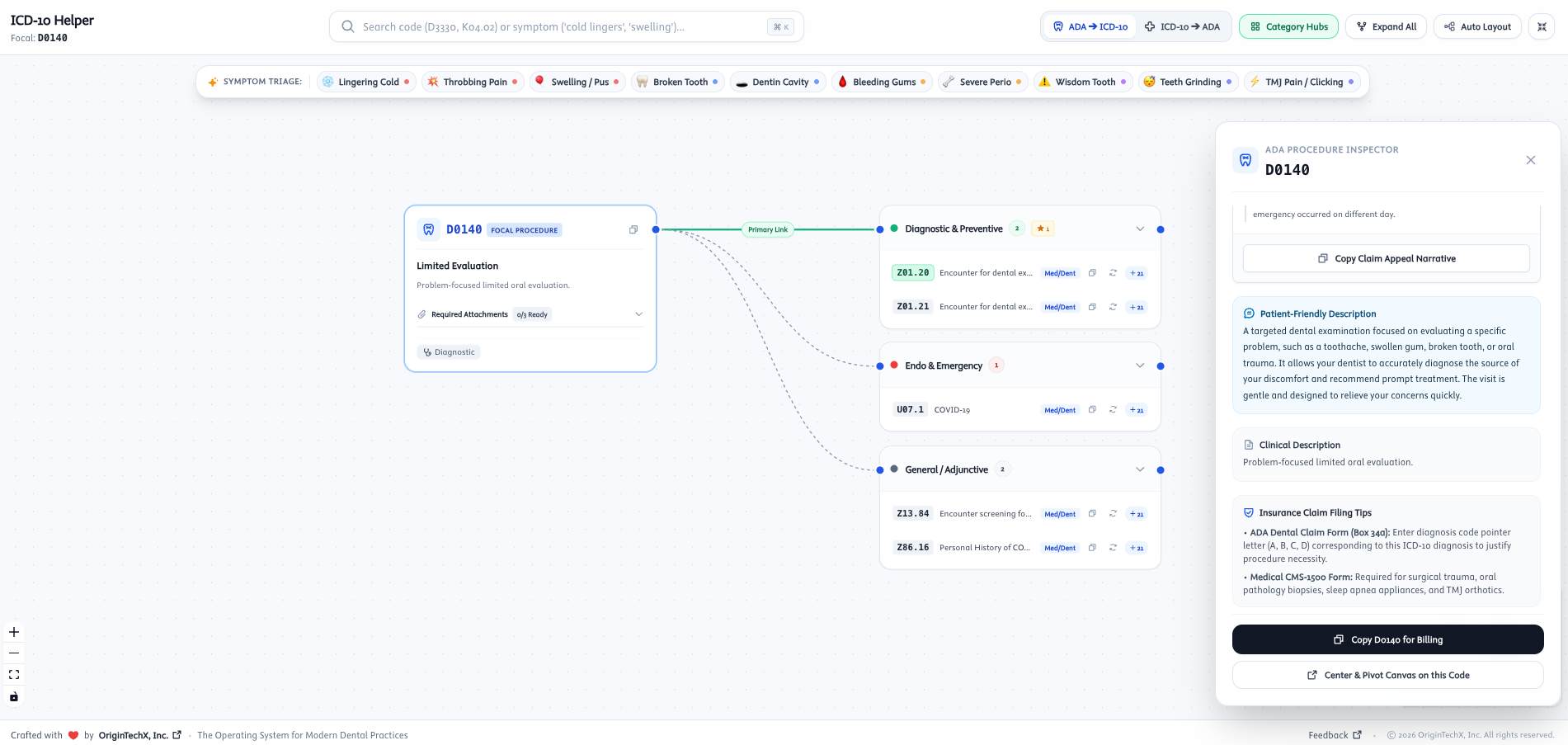
This is why we built ICD-10 Helper—an interactive clinical crosswalk tool engineered specifically to bridge the divide between dental operatories and medical billing teams.
Instead of guessing or leafing through static manuals, dental teams can use ICD-10 Helper to:
- Explore Symptoms & Diagnoses Visually: Clinicians and office managers can search directly by chief complaint, anatomical region, or trauma mechanism to navigate justified ICD-10 diagnostic branches in seconds.
- Instant CDT ↔ CPT ↔ ICD-10 Crosswalks: Enter common dental procedure codes (such as
D7210surgical extraction,D9944occlusal guard, orD7286biopsy) to immediately reveal validated medical CPT alternatives and primary diagnostic codes. - Pre-Flight Claim Attachment Guidance: Immediately view the exact medical necessity criteria and required documentation attachments (PAs, photos, trauma narratives) demanded by major medical carriers before the patient leaves the operatory.
By empowering the doctor to chart the right diagnostic code chairside and giving the front desk an instantaneous crosswalk, practices can capture thousands of dollars in legitimate medical benefits while protecting patients from arbitrary 1970s dental caps.
The Bottom Line
When dentists say “That’s the front desk’s job,” they aren’t saving time. They are passing an impossible task to their team, creating friction with patients, and leaving tens of thousands of dollars in legitimate medical reimbursements on the table.
Medical insurance is not an administrative maze designed to punish dental offices. It is an entirely different clinical paradigm—one that demands proof of disease rather than proof of work.
When the operatory provides the diagnostic foundation, the front desk can do what they do best: get claims paid cleanly, protect the patient’s finances, and eliminate aging A/R and denial fire drills once and for all.
References & Clinical Sources
- [1]Dr. Charles Blair. "Historical Analysis of Dental Benefit Plan Designs (1970–Present)." Practice Booster / Dental Economics (2023).↑
- [2]Marko Vujicic, Ph.D. & Kamyar Nasseh, Ph.D.. "Who Reaches Dental Benefit Plan Annual Maximums and What Are the Implications?." American Dental Association (ADA) Health Policy Institute Research Brief (2020).[Link]↑
- [3]U.S. Bureau of Labor Statistics (BLS). "Consumer Price Index for All Urban Consumers: Medical Care Services Index (1970–2026)." U.S. Department of Labor (2026).[Link]↑
- [4]American Dental Association (ADA) House of Delegates. "Resolution 301: Opposing Annual and Lifetime Maximums in Dental Benefit Programs." ADA Governance & Policy Actions (2024).[Link]↑

Founder at OriginTechX